
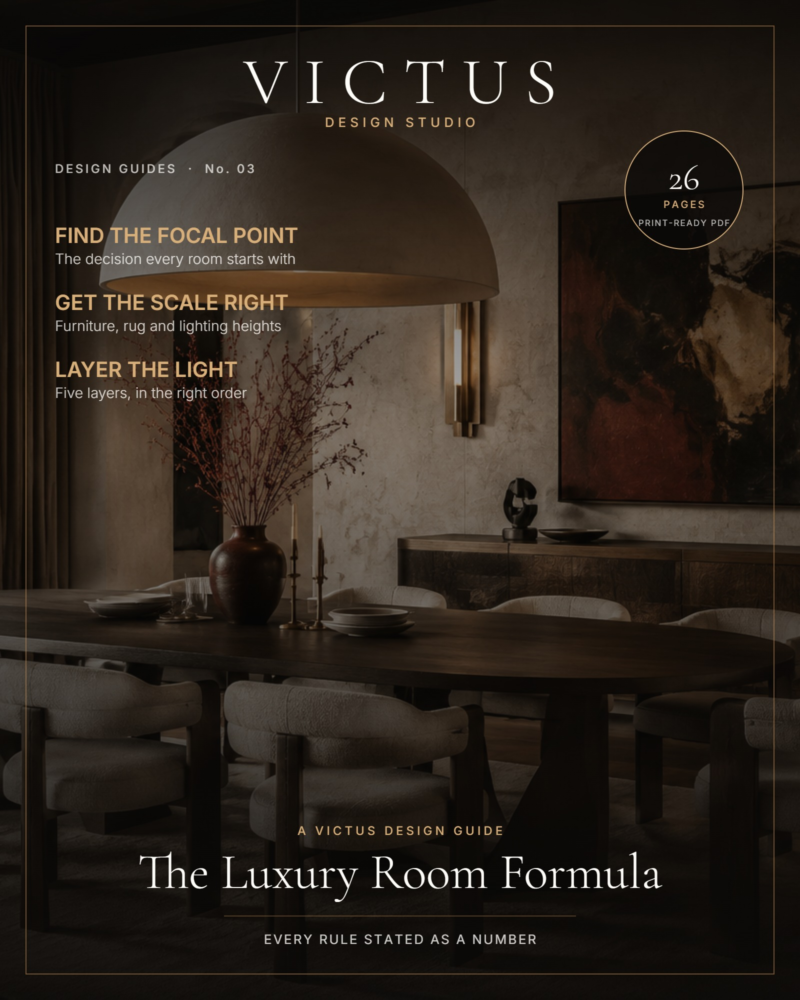
The Luxury Room Formula
26 pages on how a room is actually built — focal point, scale, rug sizing, lighting layers, colour, texture, art, styling and where the money should go. Every rule stated as a number you can measure.
26 pages · Print-ready PDF
- Chapter 01 — The focal point
- Chapter 02 — Furniture scale
- Chapter 03 — Rug sizing
- Chapter 04 — Lighting layers
- Chapter 05 — Colour balance
- Chapter 06 — Texture
- Chapter 07 — Art placement
- Chapter 08 — Styling
- Chapter 09 — High and low
- Chapter 10 — The final room checklist
Instant download. See the digital product policy before purchase.
The rules a designer works from, written down.
There is a reason two rooms with the same budget can look nothing alike in quality.
It is not taste and it is rarely the individual pieces. It is that one room has a clear focal point, correct scale, three layers of light at one colour temperature, a palette repeated deliberately, four categories of texture, art at the right height, and room to breathe — and the other has none of those, and nobody in it can say why it feels wrong.
All seven of those are measurable. This guide is the measurements, and the reasoning behind each one.
What is inside
Chapter 01 — The focal point (p. 4) How to find the one your room already has, four reliable ways to build one when the architecture gives you nothing, the doorway test, the television problem, and how the furniture plan follows from it.
Chapter 02 — Furniture scale (p. 6) Seat depth, seat height and back height and what each one governs. Ten furniture relationships that must hold, stated as rules. How to read a room’s capacity before you buy. Standard dimensions worth memorising. Visual weight, and why two 84-inch sofas can behave like different sizes.
Chapter 03 — Rug sizing (p. 9) The three acceptable conditions and the one that is never acceptable. Exact living room sizes by room dimension, from 10 × 12 up. Dining rugs by table size with the arithmetic. Bedroom sizes by bed. Entries, halls, runners, layering, and a short guide to construction.
Chapter 04 — Lighting layers (p. 11) Ambient, task and accent, and what each is actually for. Kelvin by application with a temperature table. CRI and why 90 is the threshold. Target lumens for seven rooms. Fixture sizing formulas for chandeliers, dining fixtures and island pendants. Ten mounting heights. Natural light by orientation, and reflection as a lighting layer.
Chapter 05 — Colour balance (p. 14) What 60, 30 and 10 actually refer to, and the four ways the rule is misapplied. Finding an undertone. Building a palette from the largest fixed element. Why every colour needs three placements. Whites, and why one trim white per house. Saturation and room size.
Chapter 06 — Texture (p. 16) The four categories that must all be present, a symptom table for diagnosing which one is missing, contrast within a single colour, texture at three heights, and practical specifications by room.
Chapter 07 — Art placement (p. 18) The 57 to 60 inch centre line, with the nail arithmetic worked. Sizing against a sofa, console, bed and mantel. Spacing within a group. Treating a group as one rectangle. The paper template method. Stairs, and hanging hardware.
Chapter 08 — Styling (p. 20) Odd numbers, the 2:1 height ratio, the triangle, the tray. The coffee table in four elements. The bookshelf ratio. Cushion counts and insert sizing by sofa. Greenery at scale. The subtraction pass, and how to know where to stop.
Chapter 09 — High and low (p. 22) Three tests for whether a thing deserves money. What to spend on and why. What to save on and why. The four upgrades that read as expensive and are not. A note on buying used.
Chapter 10 — The final room checklist (p. 24) 34 checks across ten chapters, plus four tests to run from the doorway before you call a room finished.
Who it is for
- Anyone who can tell a room is not right but cannot name what is wrong
- People with good taste and no formal training in proportion, scale or lighting
- Anyone about to spend meaningfully on a room and wanting the reasoning first
- Renters who cannot change the architecture and need to work within it
- Anyone who prefers a number to an adjective
Who it is not for
- Anyone looking for a style guide. This guide never tells you what to like; two rooms built to these rules can look nothing alike and both be correct.
- Anyone looking for shopping links or product recommendations. There are none.
- Anyone who wants worksheets to fill in. This is a teaching document — use The Designer’s Room Planning Workbook for the working paper.
- Anyone hoping for trend commentary. Nothing here expires.
Questions
Is this a workbook? No. It is a guide you read once and then use as a reference. Every chapter ends with the rules restated as numbers so you can return to a single page. If you want printable measurement sheets and layout grids, that is The Designer’s Room Planning Workbook.
Does it apply to a rental? Yes. Most of what is in it — scale, rug sizing, lighting layers, art heights, styling, clearances — requires no permanent change to the property.
Does it apply to my style? Yes, because it is not about style. It is about proportion, light, repetition and restraint, which behave the same way in a modern room and a traditional one.
Are the measurements in metric? No. All dimensions are in inches and feet, and lighting is in Kelvin and lumens, following conventional United States retail and construction practice.
Do I need to read it in order? The first time, yes. The chapters follow the order in which a room gets built, and the reasoning compounds. After that it works as a reference.
Is it printed or digital? An instant digital download, formatted for US Letter so you can print it at home if you prefer paper.
Read it once. Then use it on every room you touch.
26 pages · instant download · US Letter · print at home.
—
No checkout URL is set on this guide, so the page shows an enquiry button instead of a buy button. Add the checkout URL in the Design Guide editor once a payment processor is live.